How the VR Physics Lab Transforms the Iron-Filings Experiment into a 3D Discovery
Magnetism has always been one of the most frustrating topics in middle-school physics. The force is real, its effects are obvious, yet the field itself is completely invisible. The VR Physics Lab finally solves this problem, turning a classroom trick into an immersive scientific experience.
Magnetism has always been one of the most frustrating topics in middle-school physics. The force is real, its effects are obvious, yet the field itself is completely invisible. Teachers have relied on iron filings scattered over paper to give shape to the unseen, but the classic flat-board demonstration has always struggled to convey the true three-dimensional nature of magnetic fields. The VR Physics Lab in the Middle School VR Learning Device finally solves this problem, turning a classroom trick into an immersive scientific experience through interactive science experiments that students can explore at their own pace.
1. The Classic Experiment: Useful, But Flat
Every student remembers the first time iron filings magically arranged themselves around a bar magnet. The filings trace curved lines that run from the north pole to the south pole, giving the abstract idea of a ‘magnetic field’ a visible pattern. Yet the traditional setup has three unavoidable weaknesses. First, the filings sit on a flat surface, so students see only a single horizontal slice of what is actually a three-dimensional field. Second, once the filings settle, the pattern is static; students cannot watch how the field changes when the magnet moves. Third, because the filings are real particles on real paper, the experiment is messy, wasteful, and hard to repeat quickly. These limitations mean that many students walk away with a half-formed idea: they know fields exist, but they do not truly understand what a field ‘looks like’ in space.
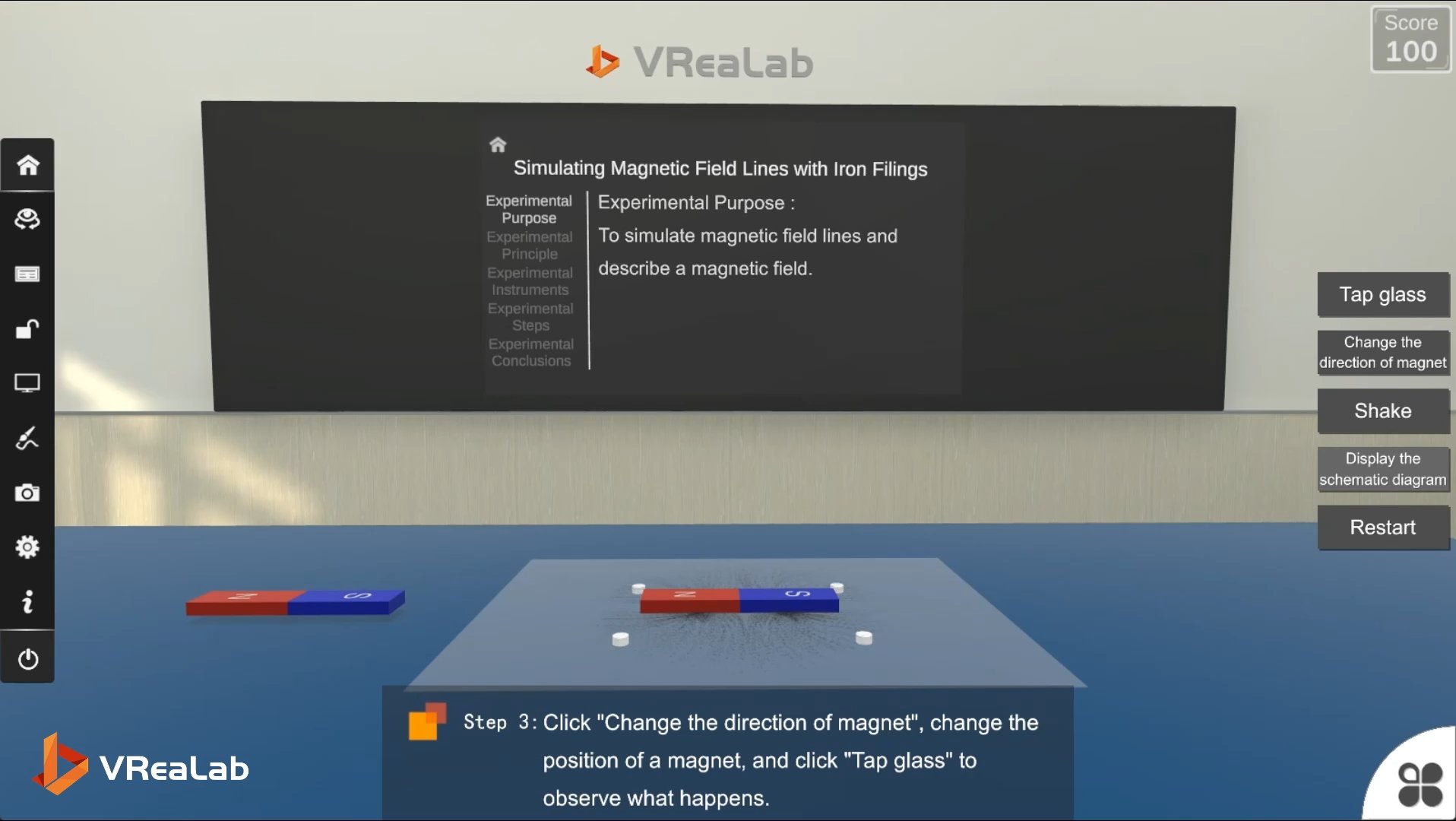
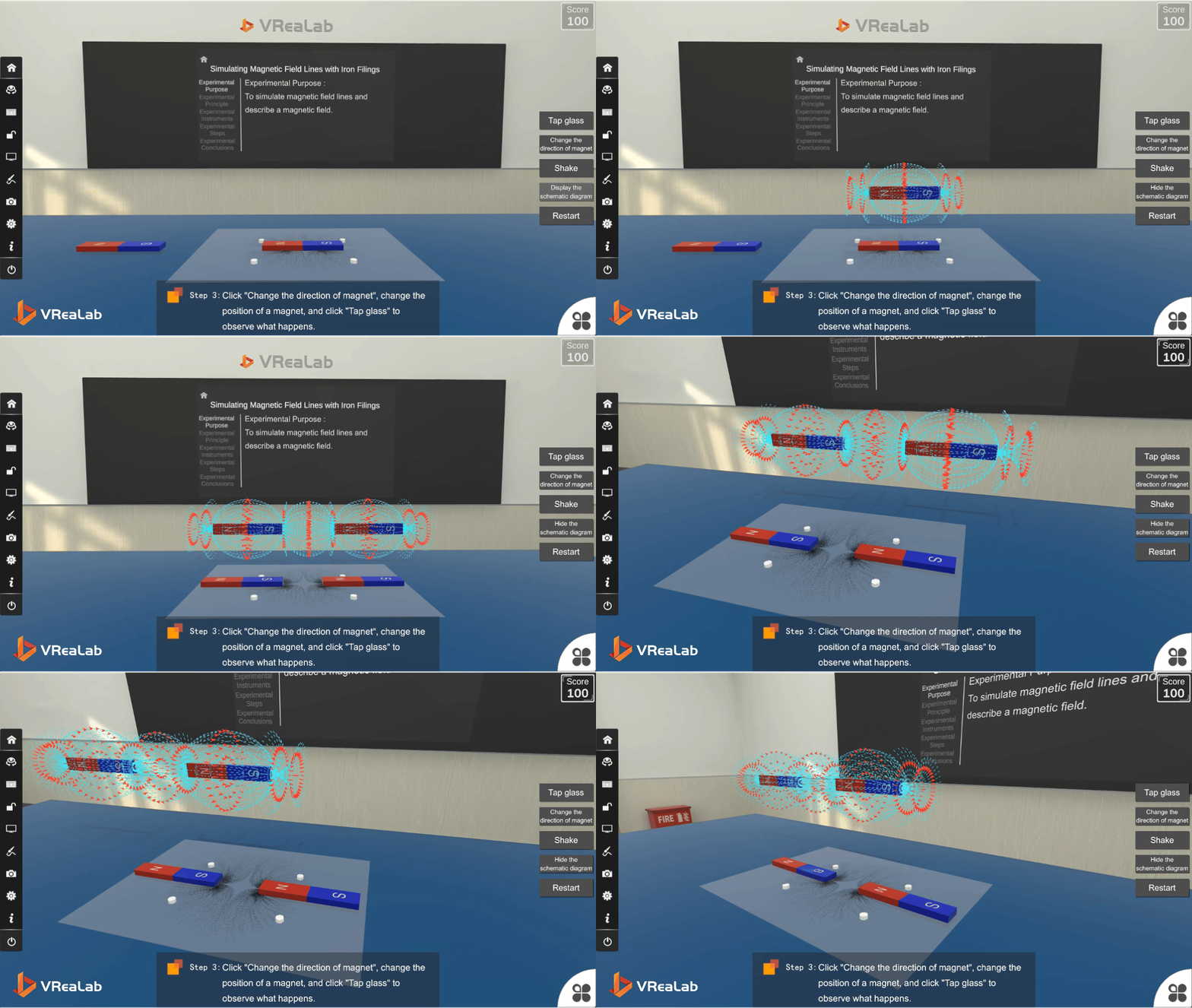
Figure 2. The initial experimental setup inside the Virtual Lab, with two bar magnets placed on the glass surface before tapping.
2. Enter the Virtual Lab: A Clean Stage for Exploration
The Middle School VR Learning Device recreates the iron-filings experiment inside a fully Virtual Lab environment. Students put on a headset and step into a digital laboratory where a glass plate, two bar magnets, and a virtual scattering of iron filings are waiting. The interface is clean and intuitive: buttons on the side let learners tap the glass, shake the filings, change the direction of the magnets, hide or display the schematic diagram, and restart the experiment at any time. Because everything is virtual, there is no cleanup, no waste, and no safety concern. The stage is set for pure, repeated exploration.
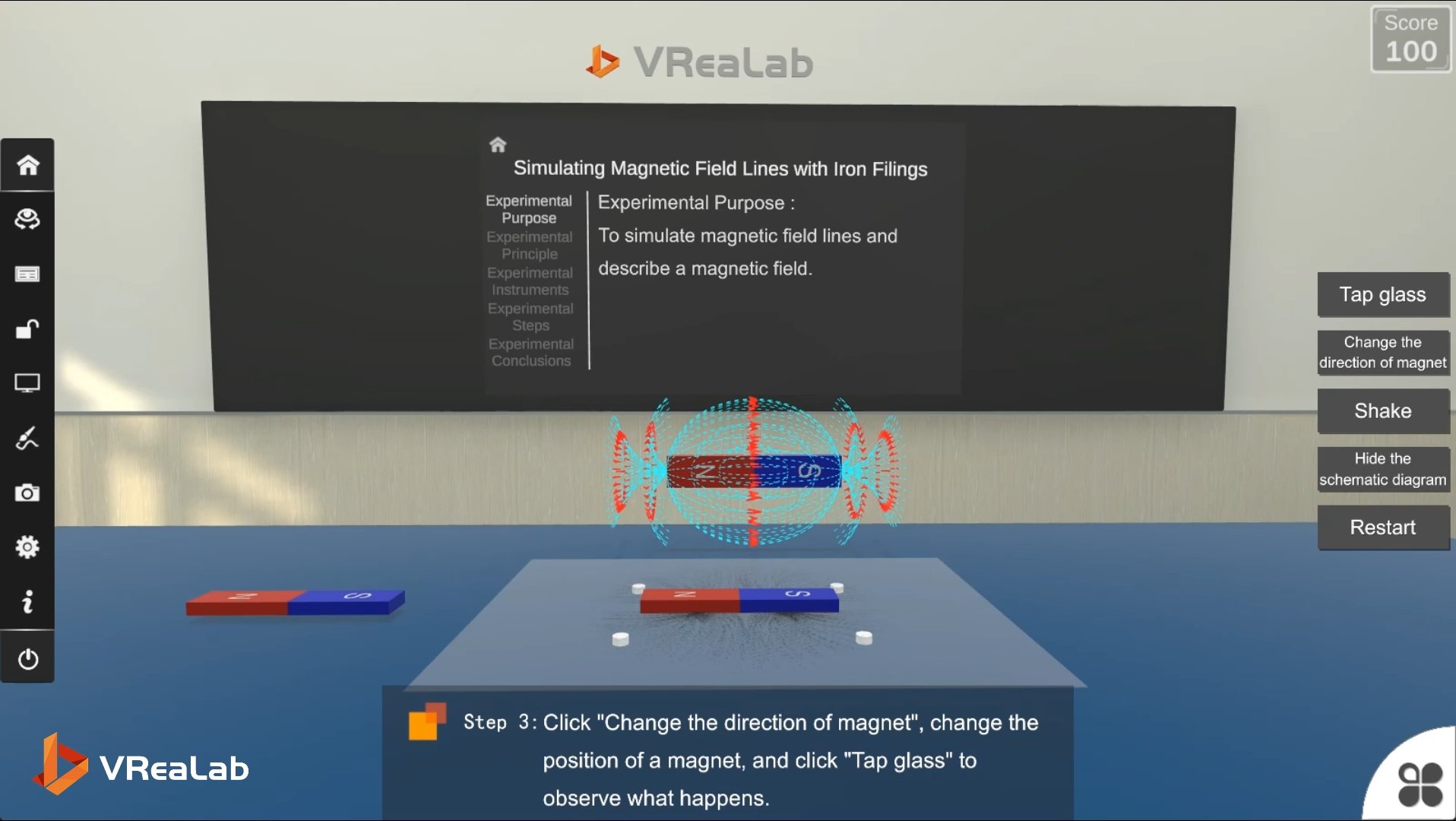
Figure 3. A single bar magnet on the glass plate reveals the characteristic field-line pattern in three dimensions, with red and blue arrows indicating field direction.
3. From Particles to Patterns: The ‘Tap Glass’ Moment
The most powerful moment in the interactive science experiments comes when the student clicks ‘Tap glass.’ Instantly, the iron filings align along the invisible field lines, transforming random dust into a precise map of the magnetic field. Students rotate around the plate, view the pattern from above, from the side, and from below. For the first time, the field is not a flat drawing — it is a living structure in space. When a second magnet is introduced, the filings reveal the curved bridges that form between opposite poles.
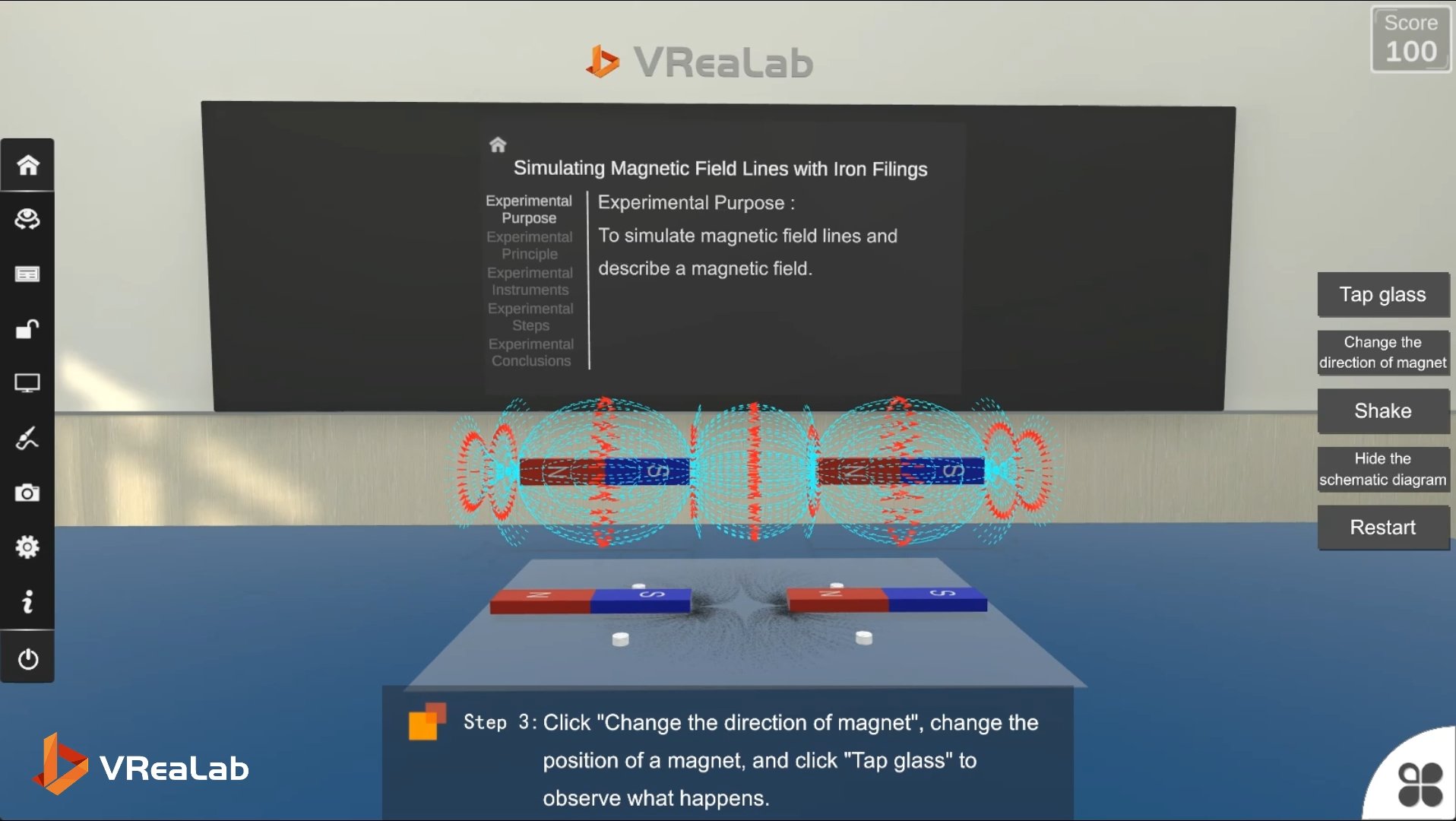
Figure 4. Two bar magnets placed with opposite poles facing each other create a dense arch of field lines between them, visualised after tapping the glass.
4. Adding Direction: The 3D Vector Arrow Overlay
Where the VR Physics Lab truly departs from the traditional demonstration is the addition of three-dimensional vector arrows. Floating above the glass plate, red and blue arrows trace the exact direction of the magnetic field at every point. Students see not only where the lines go, but which way they point. This addition transforms the experiment from a static observation into a dynamic reading exercise: learners can follow the arrows from the north pole, watch them curve through space, and converge on the south pole. The abstract idea of ‘field direction’ — something that textbooks describe with small arrowheads on flat lines — is now a vivid, spatial experience that students can walk around and inspect from any angle.
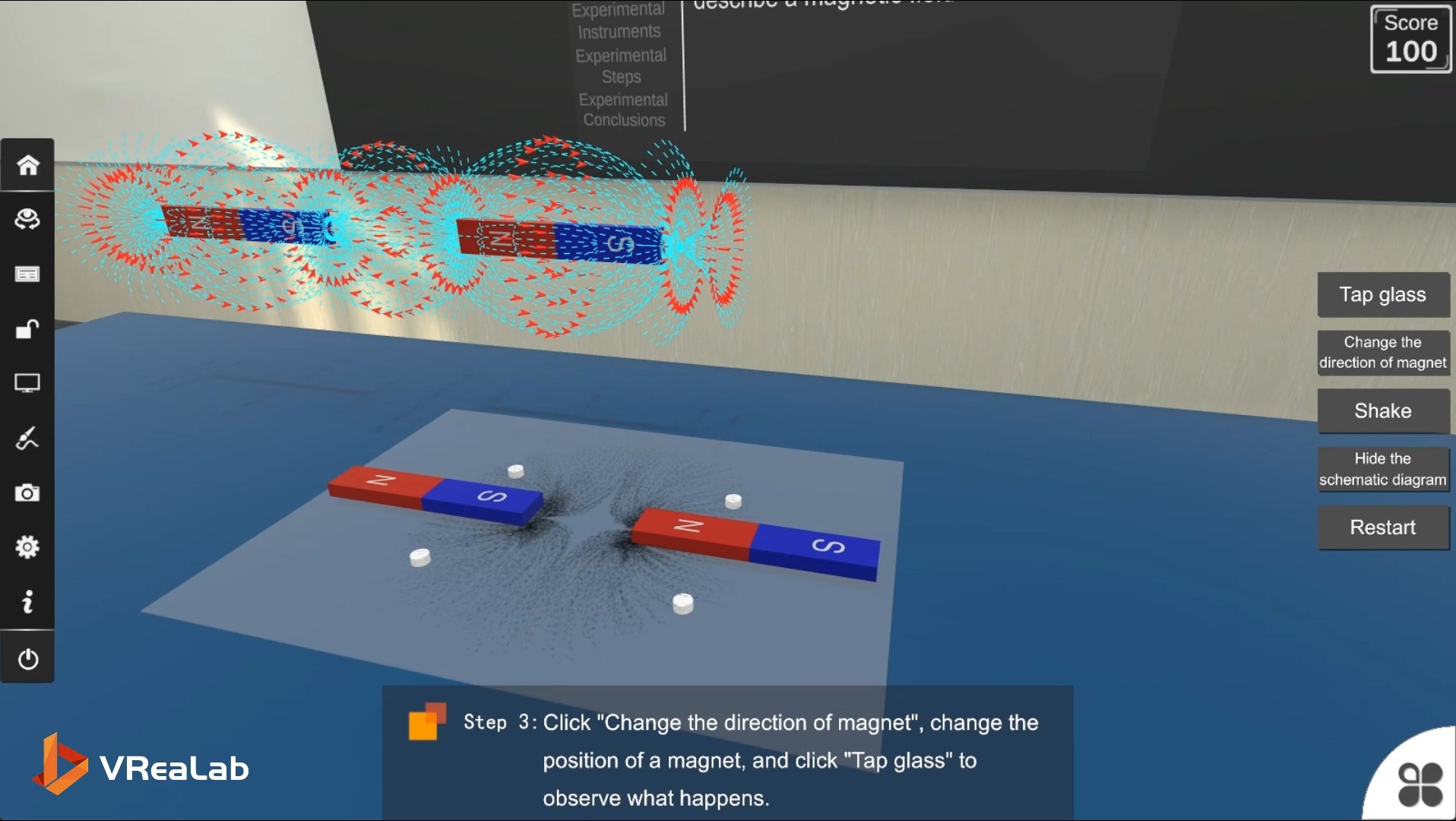
Figure 5. A close-up view showing the dense field-line pattern between two attracting magnets, enhanced by floating 3D vector arrows that indicate field direction at every point.
5. Why This Changes Everything
By the end of a session in the Virtual Lab, a student has done something previously impossible: they have ‘seen’ an invisible force in three dimensions and traced its direction through space. The iron-filings experiment is no longer a messy demonstration that produces one flat photograph. It is a repeatable, explorable lesson navigated at each student’s own pace. For teachers, less time managing materials means more time guiding discovery. For students, magnetism — one of physics’ most elegant invisible structures — is finally visible and unforgettable.