From Electron Clouds to Molecular Geometry: Bringing Atomic Architecture to Life
Atomic structure is the foundation of all chemistry — and the topic students find hardest to grasp. Discover how the VR Chemistry Lab transforms invisible electron clouds, orbitals, and molecular geometry into interactive 3D experiences.
Atomic structure is the foundation of all chemistry — and the topic that students find most difficult to grasp. The reason is simple: atoms are invisible. No microscope in a school laboratory can reveal an electron cloud or display the shape of an atomic orbital. Teachers draw circles and arrows on a whiteboard, and students are expected to construct accurate mental models of quantum-mechanical behavior from two-dimensional sketches. It is no wonder that the periodic law of elements, electron-filling sequences, and principles like the Pauli exclusion principle, Hund's rule, and the Aufbau principle remain abstract and poorly understood.
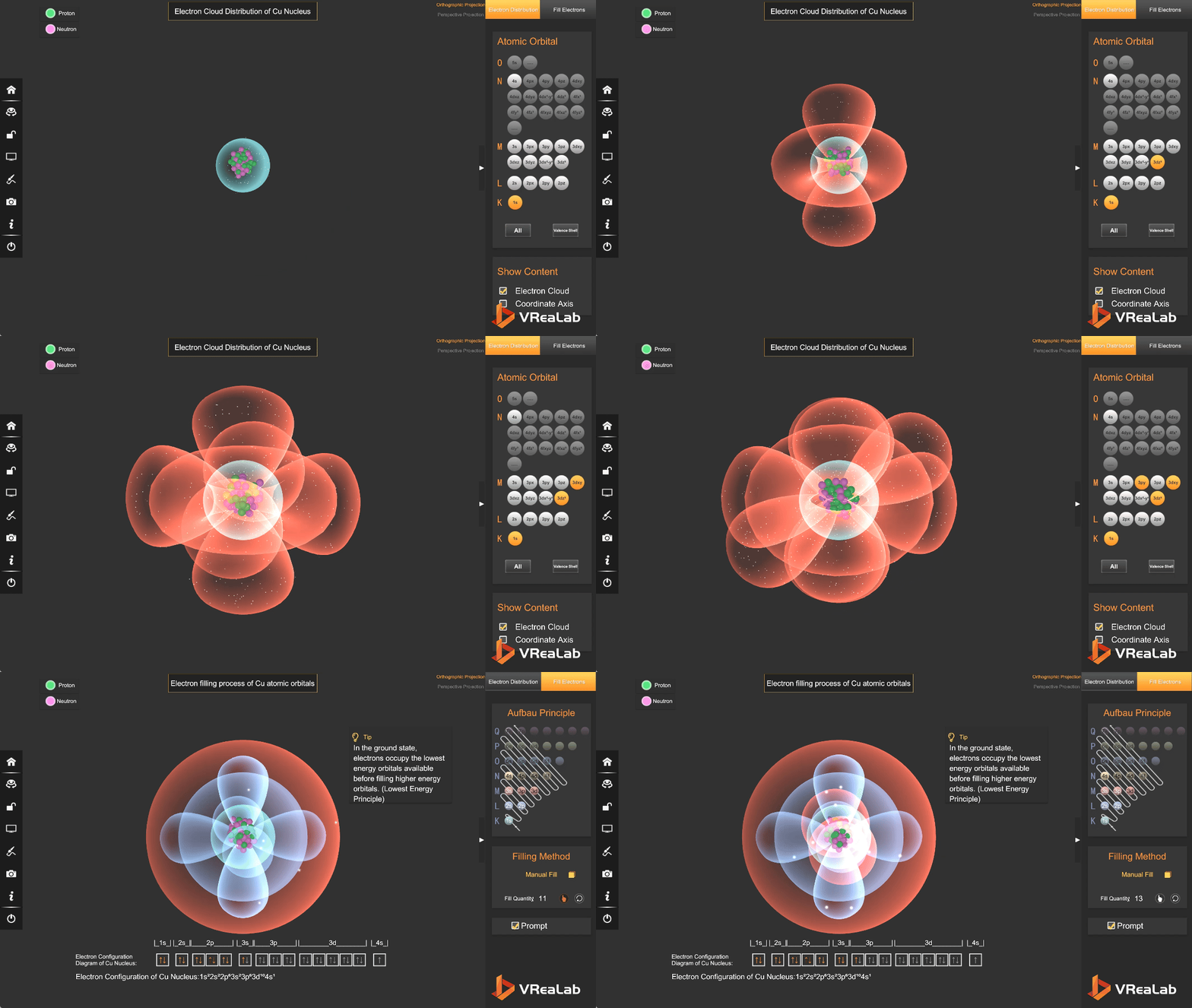
VReaLab Chemistry Material Structure addresses this challenge head-on through a powerful VR Chemistry Lab that visualizes what has always been invisible. In the atomic structure module, students do not look at static diagrams of Cu — they interact with a dynamic Atomic Structure Simulation that displays electron clouds, atomic orbitals, and coordinate axes in fully three-dimensional space. They can track electron-filling sequences step by step, watching how each orbital is populated according to the Pauli, Hund, and Aufbau principles. The abstract architecture of the atom becomes instantly intuitive when students can see it, rotate it, and explore its structure from multiple angles.
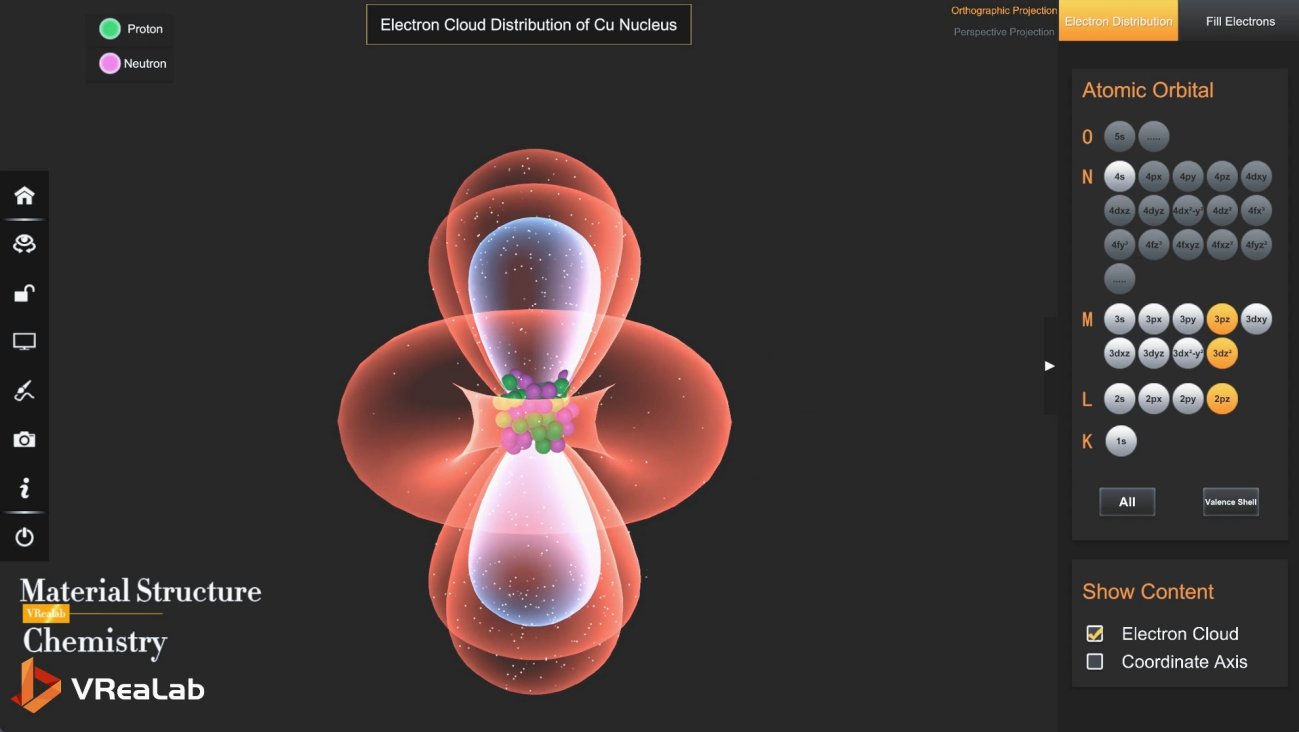
This Atomic Structure Simulation goes far beyond what any physical model or textbook illustration can achieve. Traditional ball-and-stick models show atoms as solid spheres, which is fundamentally misleading — it reinforces the misconception that atoms are like tiny billiard balls rather than complex probability distributions of electrons. The VR Chemistry Lab replaces this oversimplification with accurate visualizations of electron density, orbital shapes, and energy levels, giving students a scientifically faithful picture of atomic structure that builds the foundation for everything they will learn about chemical bonding and reactivity.
From Atomic Orbitals to Molecular Geometry: VSEPR in Three Dimensions
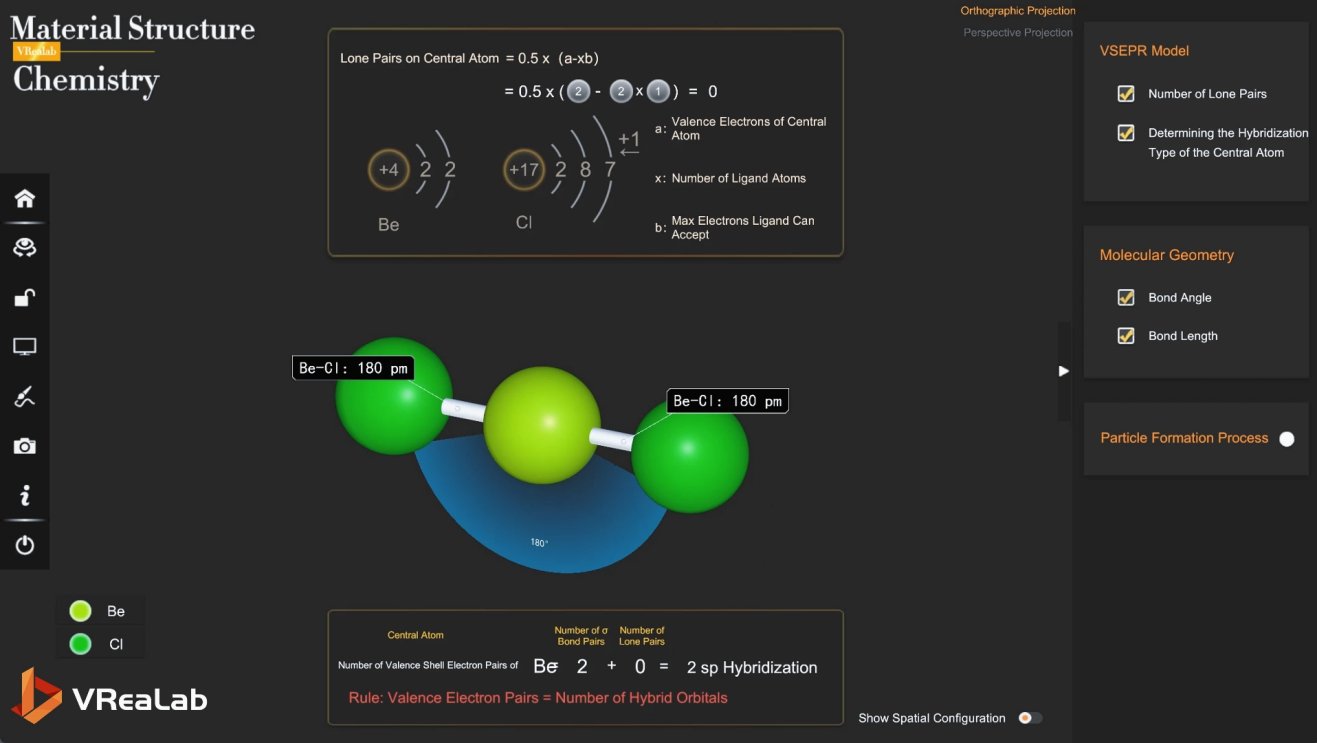
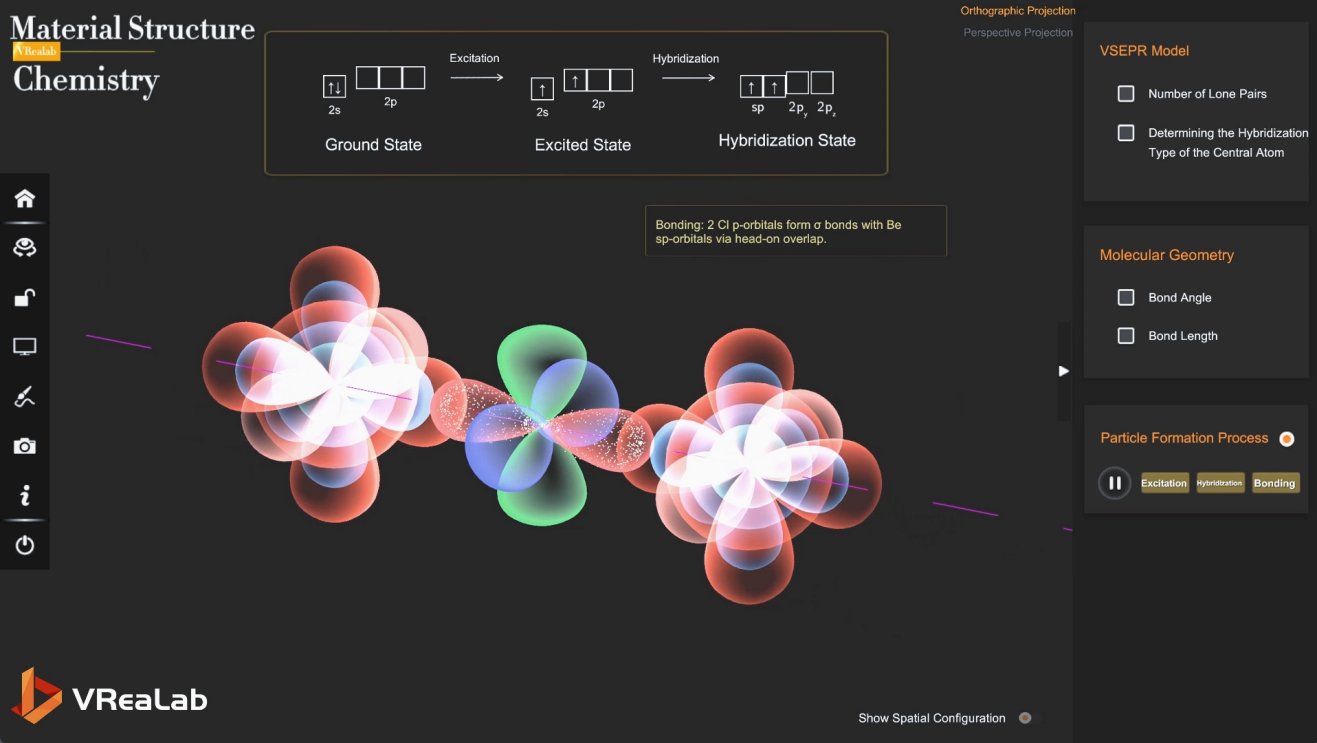
Once students understand atomic structure, the curriculum guides them naturally into molecular geometry. The molecular structure module explores three-dimensional spatial configurations and molecular polarity using VSEPR theory and hybrid orbital models. Taking BeCl₂ as an example, students observe covalent bond formation in real time, use an interactive VSEPR calculator to predict molecular shape, and examine bond parameters such as length and angle through assembly animations. The dynamic bonding process and geometric evolution are displayed clearly, allowing students to see how individual atoms combine into a 3D Chemistry Structure with specific properties.
Seeing is Understanding: How Visualization Builds Chemical Intuition
The key advantage of this approach is that it transforms the logical chain of chemistry — structure determines property, property determines behavior — from a theoretical assertion into an observed reality. When students watch a linear BeCl₂ molecule take shape through VSEPR-guided assembly, they do not need to be told that the molecule is nonpolar. They can see the symmetry themselves. When they trace the step-by-step electron filling of copper, they understand the periodic law not as a rule to memorize but as a pattern they have witnessed firsthand.
By combining Atomic Structure Simulation with interactive 3D Chemistry Structure models, the VR Chemistry Lab makes the microscopic world accessible, hands-on, and deeply relevant. Students who once struggled to picture an orbital now navigate through one. Students who once memorized VSEPR rules now discover them through experimentation. The result is a learning experience that builds not just knowledge but genuine chemical intuition — the ability to think in three dimensions about structures no human eye can see.