VR Chemistry Lab: Turning Abstract Crystal Calculations into Something Students Can Count
Crystal calculations are the most lost-mark topic in senior high chemistry — coordination numbers, ions per unit cell, interstitial filling, density. The VR Chemistry Lab makes the lattice rotatable, the counting explicit, and the sharing fractions observable, turning abstract formulas into something students can see.
Ask any senior high school chemistry teacher which part of Structure and Properties of Matter causes the most lost marks, and crystal calculations will be near the top of the list. Coordination numbers, ions per unit cell, interstitial filling rates, unit cell density: every one of these is a calculation about a three-dimensional object that students have never actually seen. Textbook figures show one frozen view, and the shared-lattice contribution method, the famous eighth-of-an-ion rule, stays an abstraction. The Chemistry Material Structure module inside the VR Chemistry Lab was designed to break exactly this bottleneck, and its Analysis and Calculation panel shows how.
Coordination Number: From Formula to Counting
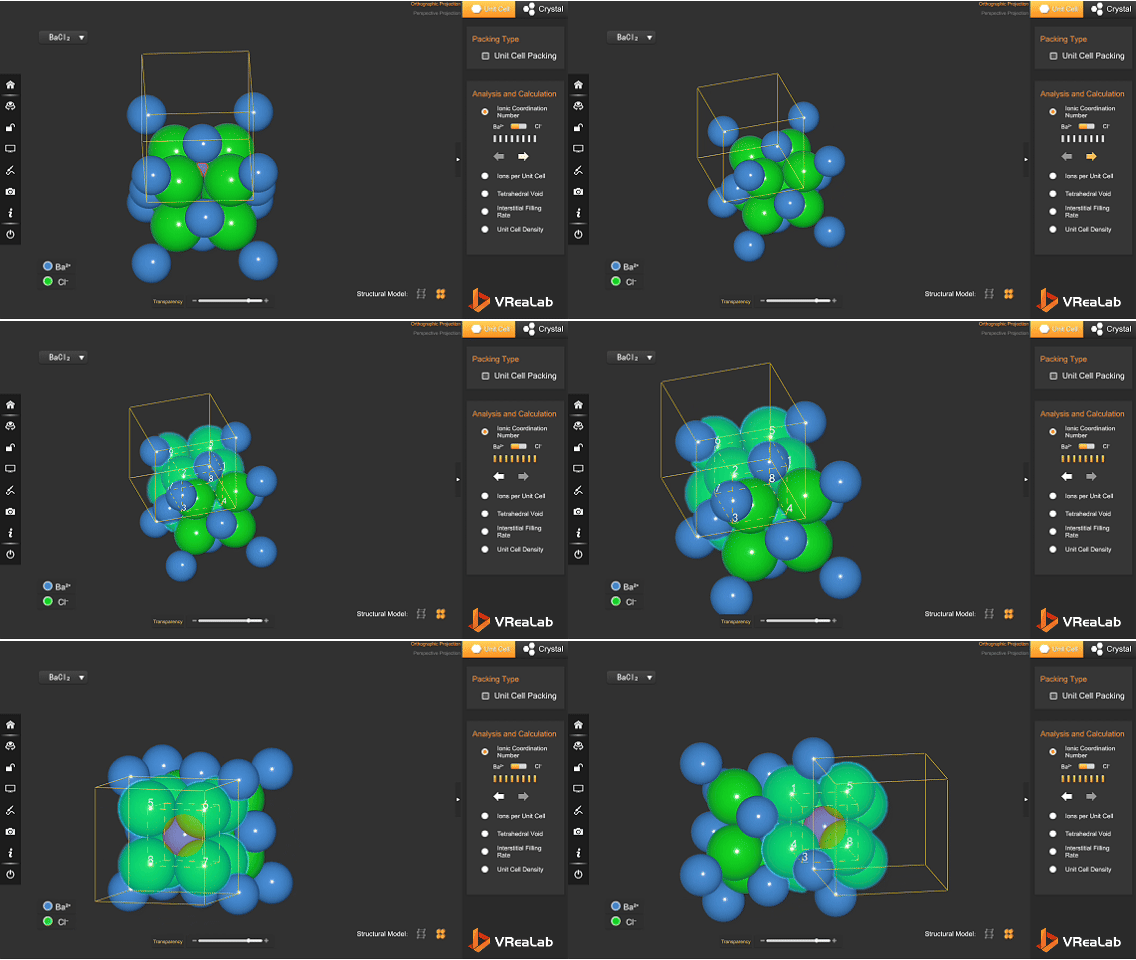
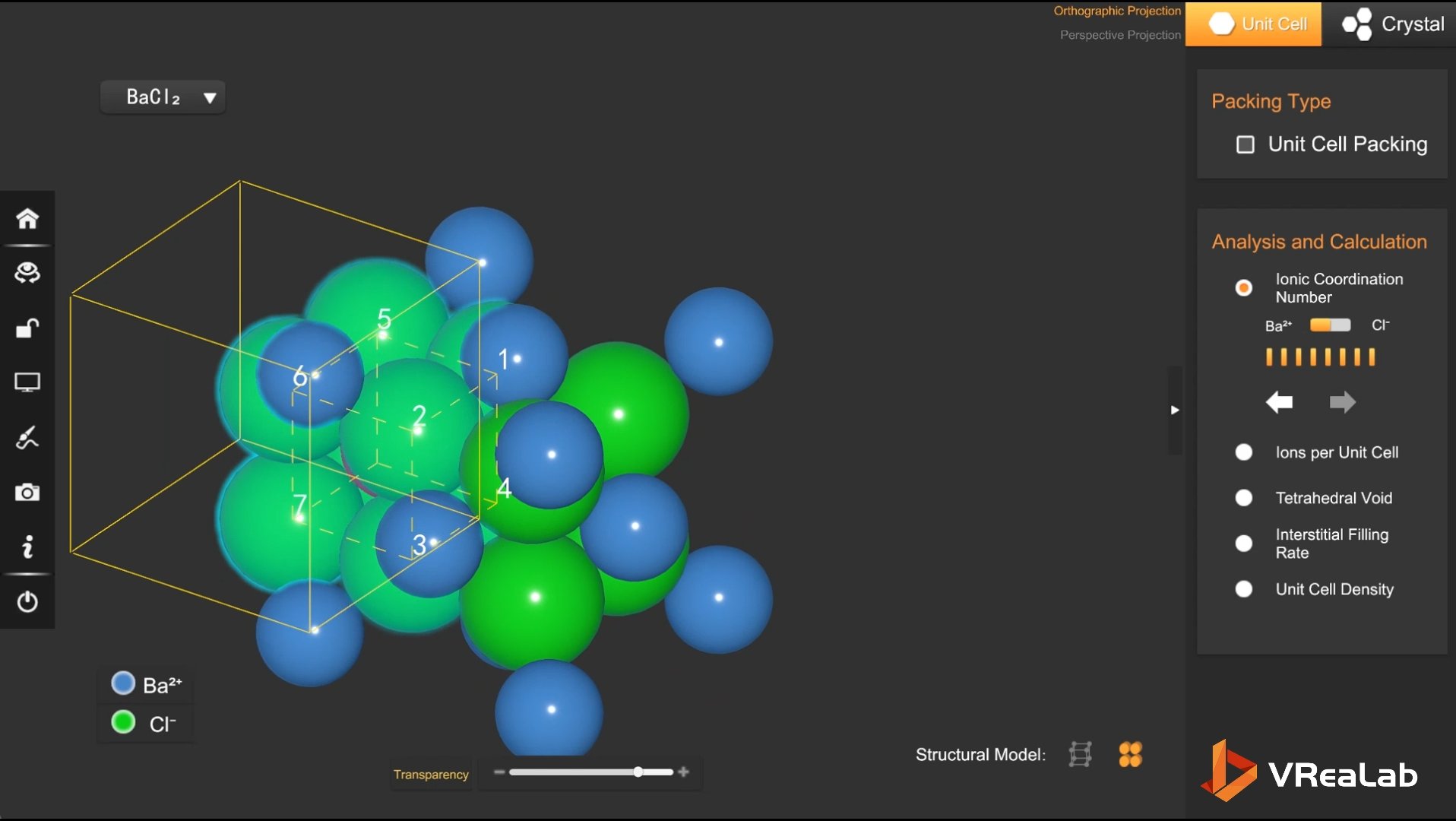
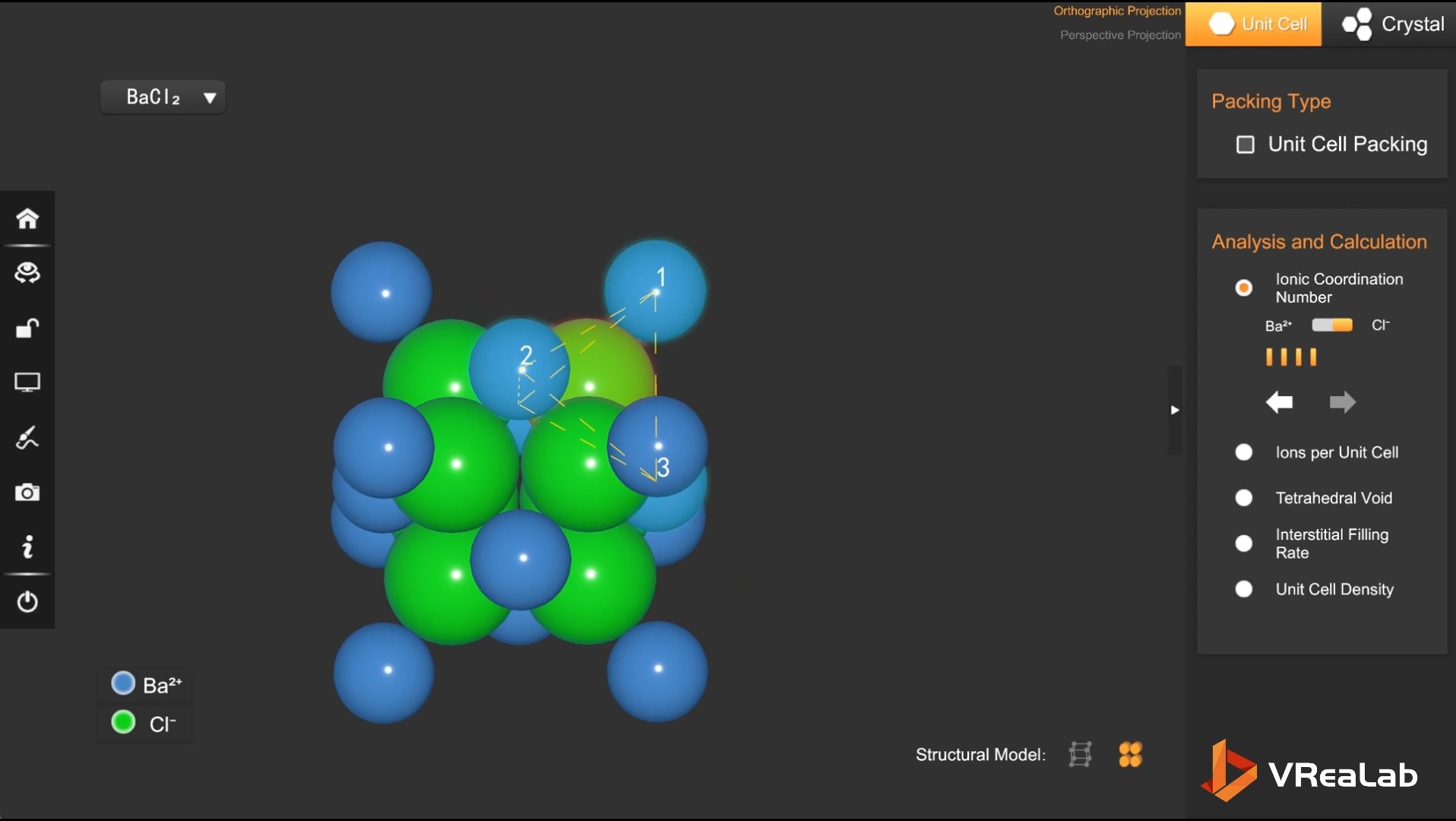
Take the coordination number of BaCl2. In the traditional classroom, the answer is announced and memorized. In the VR module, the Ionic Coordination Number option is selected and the software counts with the student: neighboring ions light up one by one, numbered 1, 2, 3, and onward, while an orange indicator bar fills up in the right-hand panel. Students watch the count reach eight for one ion, then switch the toggle from Ba2+ to Cl- and count again for the opposite ion. Because the counting is visible step by step, students understand why the numbers differ and where each neighbor sits in the lattice, instead of trusting a memorized pair of values.
Unit Cell Sharing: Seeing Why a Corner Counts as One Eighth
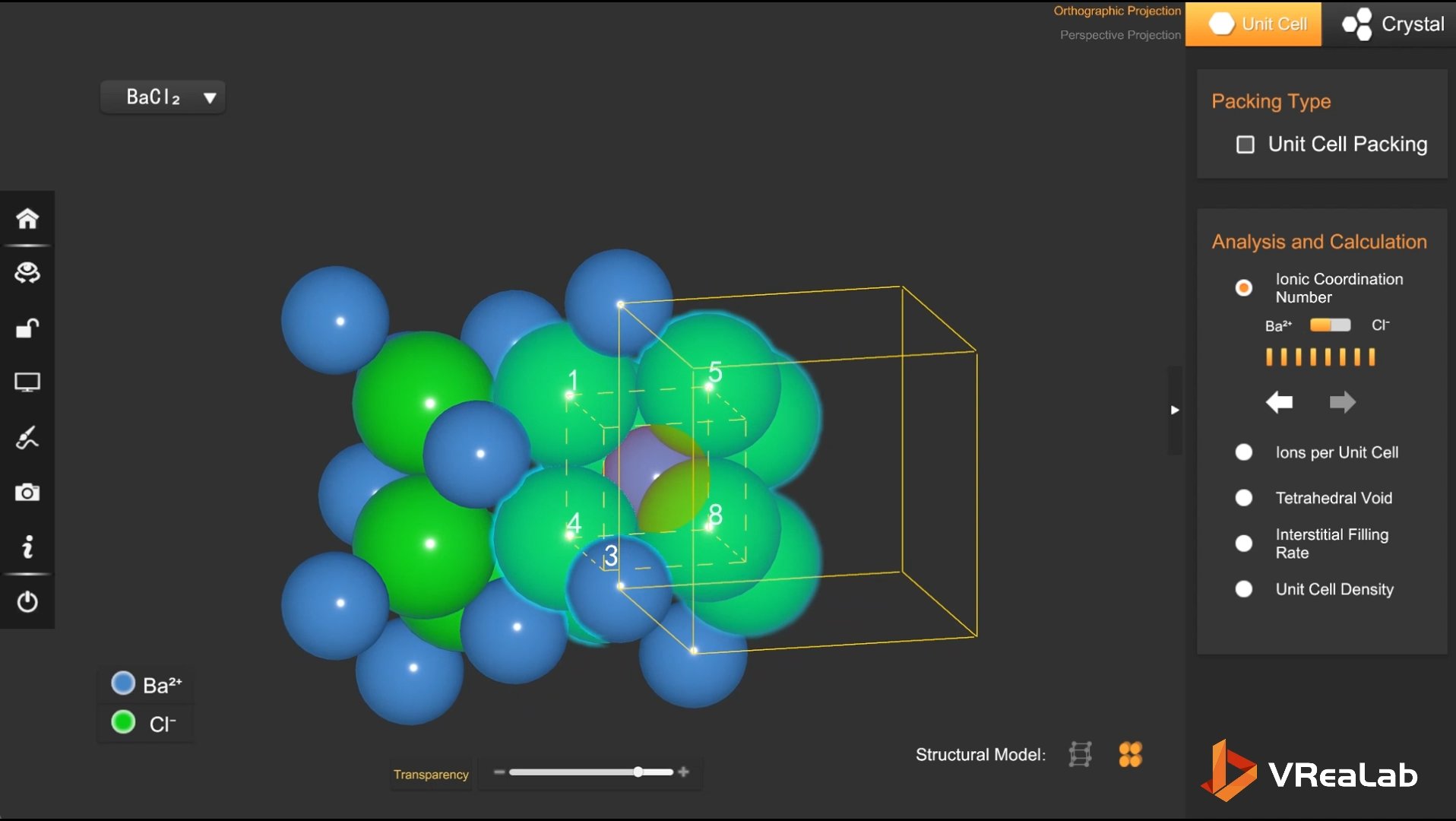
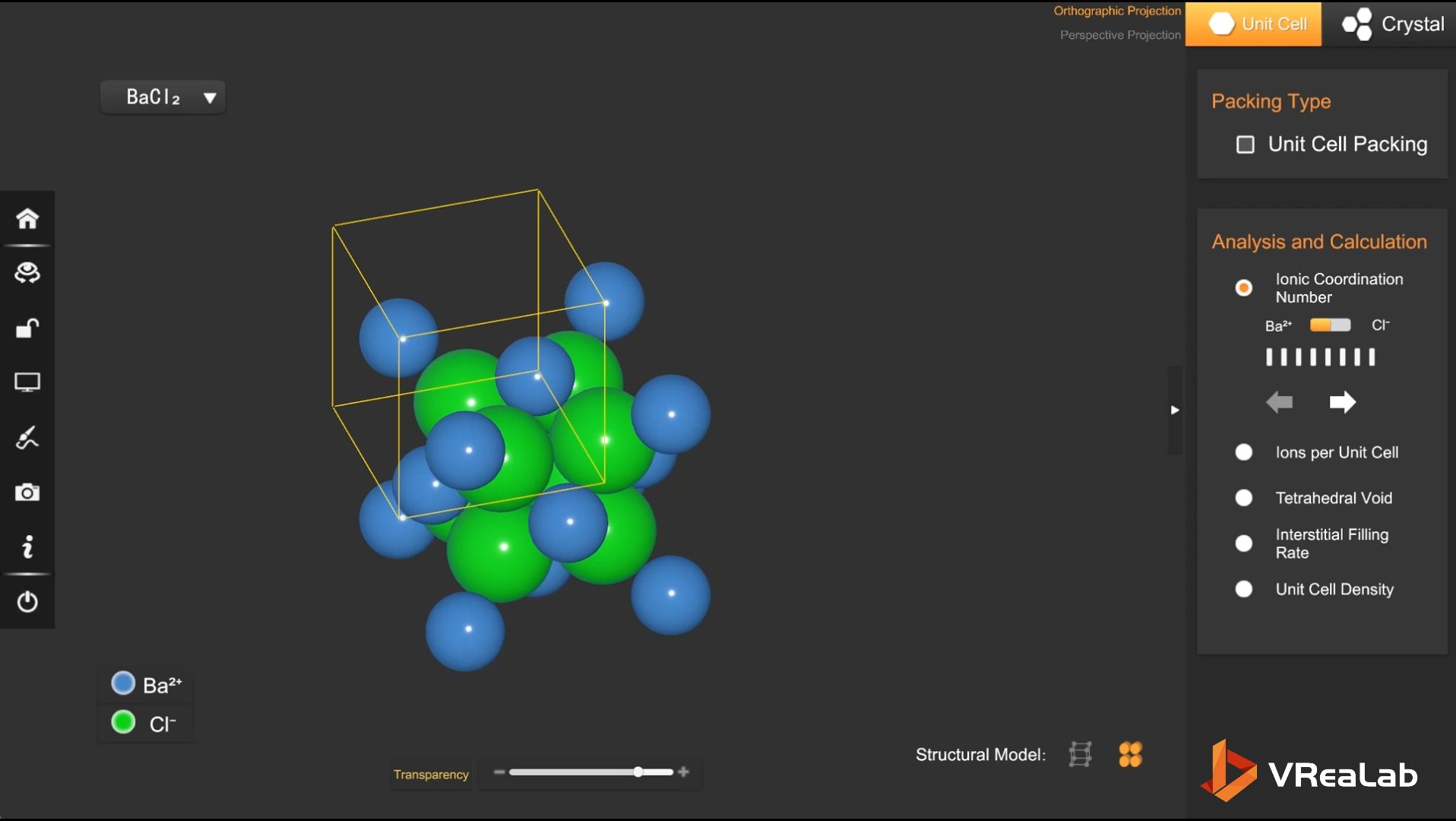
The second abstraction is the unit cell itself. The module draws a yellow wireframe cube around the crystal, and students can switch between Unit Cell and Crystal views to see how one small cube sits inside an endless lattice. An ion at a corner clearly belongs to eight adjoining cubes at once; an ion on a face belongs to two. This is the geometric fact behind ions-per-unit-cell calculations, and on a flat page it is pure imagination. In this Crystal Structure Visualization, students rotate the model, watch the neighboring cubes, and derive the sharing fractions themselves.
One Panel, Four More Calculations
Beyond the coordination number, the same panel carries the other standard calculations of the chapter: Ions per Unit Cell, Tetrahedral Void, Interstitial Filling Rate, and Unit Cell Density. Each option re-renders the same model with the relevant structures highlighted, so one crystal becomes the setting for the whole unit rather than a new diagram every lesson. A transparency slider peels the outer spheres away when an interior void needs to be inspected, and the projection can be switched between orthographic and perspective views. These are the features that make a VR Chemistry Lab more than an animation library: the geometry, the counting, and the calculation stay connected on one screen.
Density: The Calculation That Finally Makes Sense
Unit cell density is where the chapter usually collapses into symbol shuffling. Students plug numbers into a formula without understanding where either the mass or the volume comes from. In the VR module, the same wireframe cube they have been inspecting supplies both: the ions-per-unit-cell count gives the mass, and the visible edge geometry gives the volume. Because students have already watched corner and face ions being shared, the Z value in the density formula is no longer a given but a result they counted with their own eyes. The calculation becomes the last step of an observation rather than the first step of a memorized procedure, and that order is exactly what separates understanding from recall.
Conclusion
Crystal calculations are hard not because the arithmetic is difficult, but because the objects being calculated are invisible. By making the lattice rotatable, the counting explicit, and the sharing fractions observable, Crystal Structure Visualization converts the most abstract chapter of senior high school chemistry into a sequence of things students can see, count, and explain. The formula sheet stops being the starting point and becomes the summary of what students have already witnessed.