Human Physiology VR Digital Course: From "Hard to Explain" to "Easy to See"
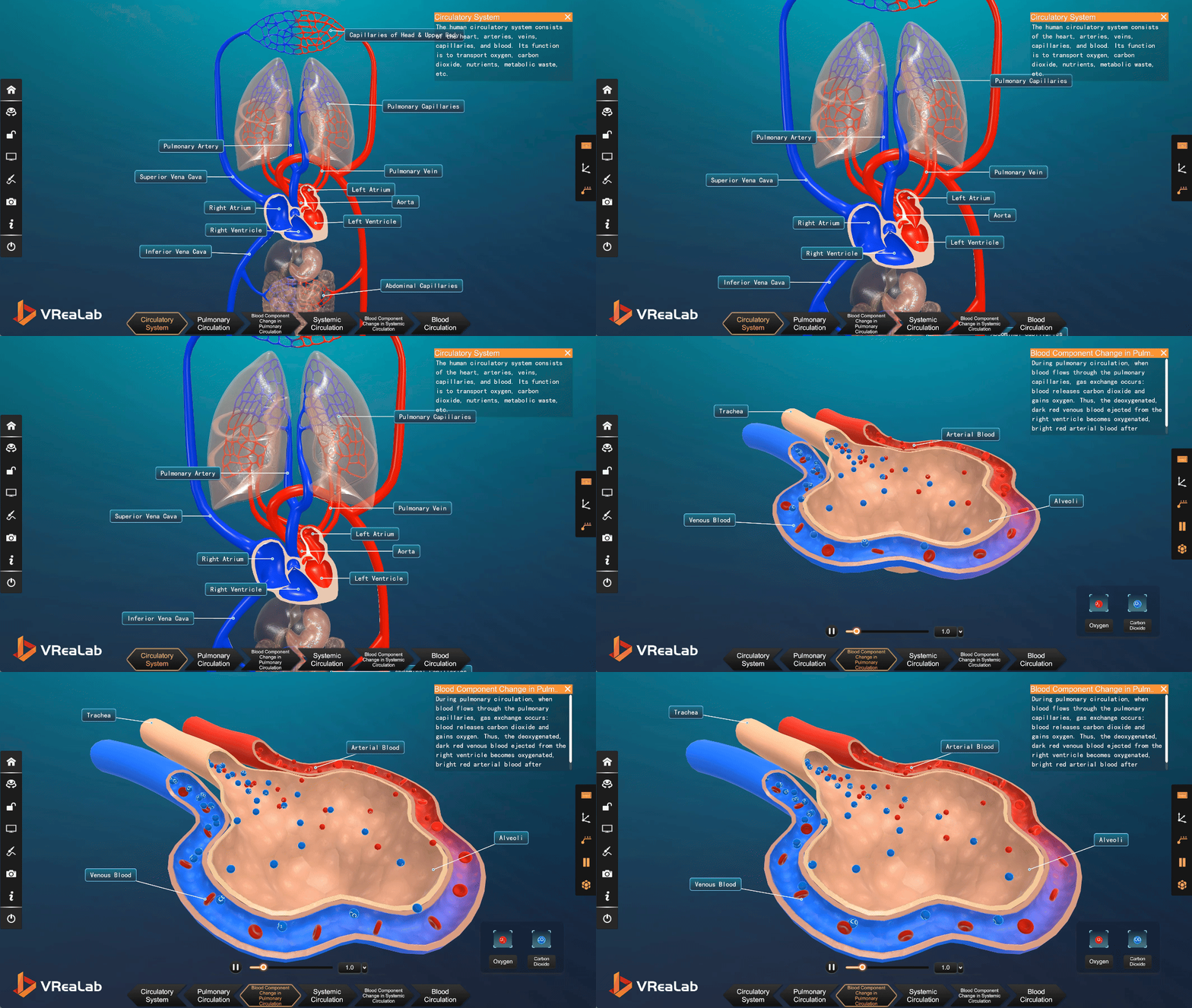
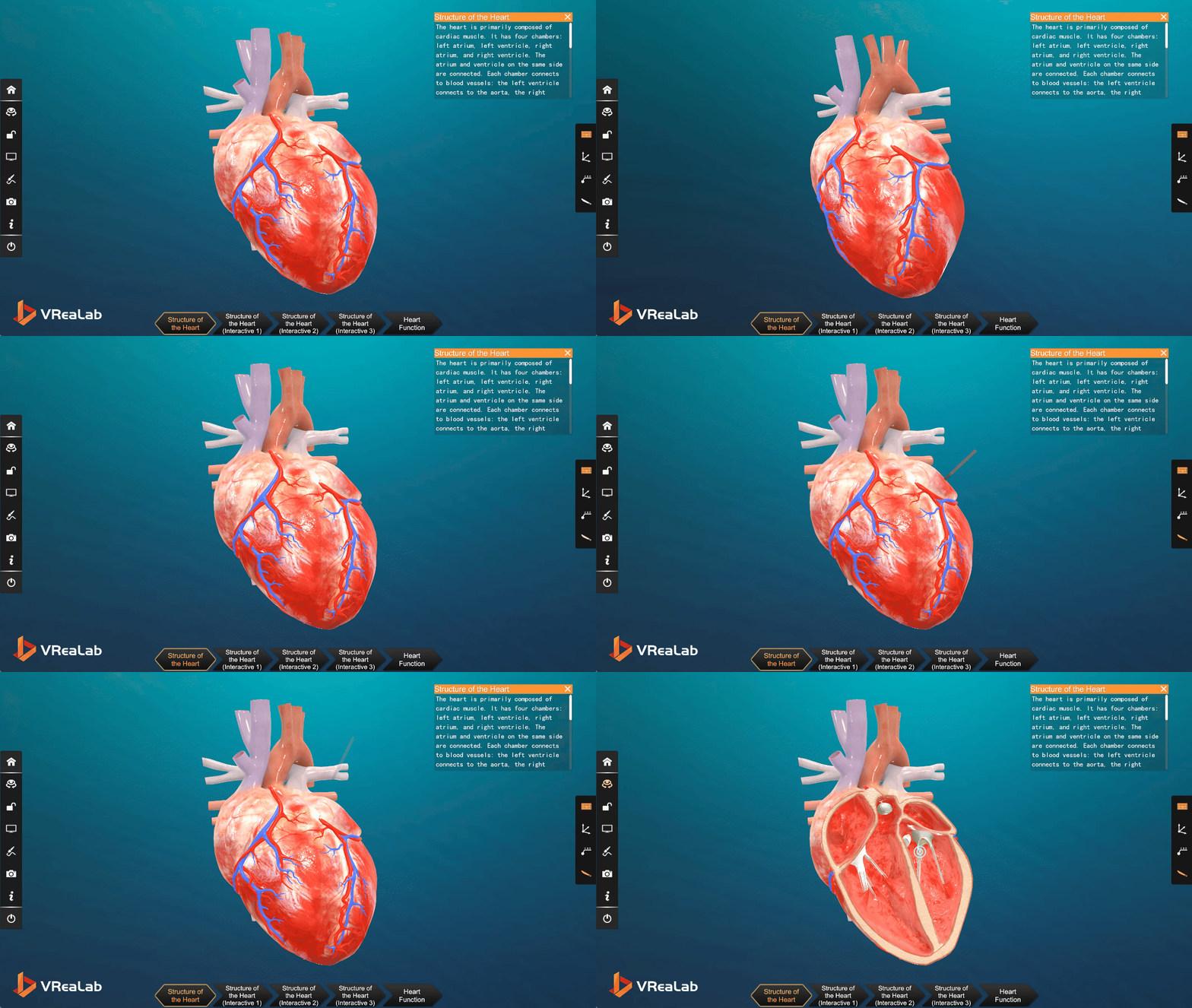
JuDao's Human Physiology Function VR Digital Course transforms abstract biology concepts like blood circulation and gas exchange into immersive, interactive 3D experiences that students can observe and manipulate.
Driven by the new curriculum standards and the 2023 curriculum reform plan, the "new teaching and learning model integrating information technology" is moving from concept to classroom. However, human physiology teaching has long faced a practical challenge: core topics such as blood circulation, gas exchange, and respiratory movement are invisible and intangible. Relying solely on text and 2D diagrams, students struggle to build intuitive understanding, and teachers often find themselves "talking until they're hoarse, while students still seem only half-understanding."

JuDao's Human Physiology Function VR Digital Course is an application-oriented tool designed to directly address this teaching pain point. With visualization, immersion, and interactivity as its technical core, it is more than just a VR resource library — it is a practical,常态化-ready teaching solution. The following sections explain how it transforms every biology class, drawing on real classroom application scenarios.
1. Classroom Introduction: Igniting Student Curiosity Through Immersive Experience
The starting point of teaching lies in capturing attention. Traditional introductions mostly rely on images or short videos, with students passively watching and limited interest激发. In classrooms using the JuDao VR digital course, however, teachers can directly play a dynamic simulation video of human respiratory movement during the context introduction phase, or even let students "step inside the lungs" through VR headsets — with the nasal cavity, trachea, and lung lobes clearly displayed in a surround-view perspective, and the rise and fall of the thorax during breathing feeling真实可感.
This process takes only 1–2 minutes, yet instantly pulls students from their日常 state into the "inner world of the human body." Students are not told "today we're studying the respiratory system"; instead, they actively generate questions: "How do the lungs work?" "How does gas get in and come back out?" — learning motivation arises naturally. This is the power of biology interactive learning powered by VR.

2. Knowledge Exploration: From Passive Listening to Active Operation
The new curriculum standards emphasize student-centered, inquiry-based learning, but in traditional classrooms, students lack operable physiological models. The JuDao VR digital course fills this gap. Taking the lesson "Gas Exchange Inside the Lungs" as an example, teachers can design cooperative group inquiry tasks within the VR Biology Lab environment:

(1) Group 1 students operate the VR respiratory movement simulation model, dragging the diaphragm and intercostal muscles in the model to直观 observe the dynamic chain reaction: "contraction → thorax expansion → lung expansion → inhalation";
(2) Group 2 students enter the microscopic视角 of the alveoli, zooming in to examine the thin-layer structure of the alveolar wall and its tight adherence to capillaries, discussing "why gas exchange can complete so quickly" — exploring 3d anatomy of the human body at the cellular level;
(3) The whole class shares each group's findings via screen casting, and the teacher guides the summary of respiratory movement patterns.
In this process, students are no longer just listening — they observe, operate, discuss, and draw conclusions like scientists. Previously abstract teaching difficulties — such as "inhalation is an active process, exhalation is a passive process" — are effortlessly overcome the moment students drag and zoom in the VR Biology Lab.
3. Extension and Deepening: Building a Holistic System Understanding
Human physiology teaching goes beyond individual organs or systems; it requires students to establish the biological concept that structure adapts to function. After completing the respiratory system study, teachers can use the VR digital course to guide students further in exploring the connection between the respiratory and circulatory systems: How does oxygen enter the blood from the alveoli? How is carbon dioxide transported to the lungs for exhalation? By connecting VR resources of both systems, students can construct a cognitive framework that "the human body is an integrated whole," laying a solid foundation for subsequent learning through biology interactive learning.


4. Routine Implementation: No Extra Burden on Teachers, No Disruption to Classrooms
Many schools have concerns about VR teaching: Is the设备 operation complex? Does lesson preparation take a lot of time? JuDao's Human Physiology Function VR Digital Course is specifically designed for常态化 teaching, paired with the JuDao VR播控 system. Teachers can manage the classroom and access resources with one click, requiring no technical background. The course itself provides systematic teaching materials — models, animations, experiments, and assessments are all included. Teachers do not need to search for scattered materials themselves; they can directly rely on the course content to design lesson plans, significantly reducing preparation burden.
At the same time, the course supports multiple teaching modes: teachers can use screen casting for whole-class instruction, or let students wear VR devices in groups for cooperative inquiry. The two modes switch flexibly, making VR a genuine "daily tool" for the classroom rather than a "performance prop" for open lessons.
Conclusion: Making Every Physiology Class "Visible, Explorable, and Memorable"
JuDao's Human Physiology Function VR Digital Course is not a堆砌 of technology, but a response to real teaching pain points. It transforms abstract physiological processes — respiration, circulation, gas exchange — into immersive experiences that students can observe, operate, and discuss. It frees teachers from "struggling to describe" and shifts students from "passive memorization" to "active construction." Through the VR Biology Lab, biology interactive learning becomes truly tangible, and 3d anatomy of the human body is no longer a distant concept but a vivid reality students can explore firsthand.
Source: Judao Edu