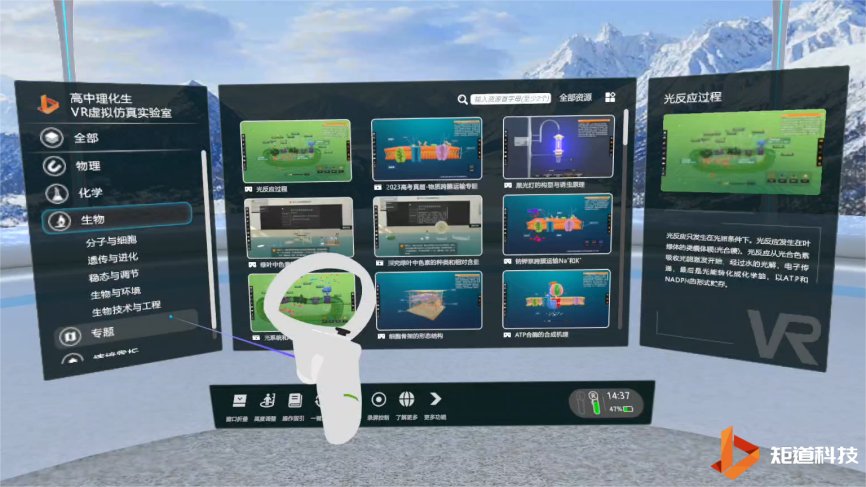
Empowering Senior Exam Prep: JuDao Virtual Simulation Lab Brings Physics Problems to Life — Highlights from Urumqi High School Physics Teaching Research Event
JuDao virtual simulation laboratory transforms static physics exam questions into dynamic, interactive experiments, supporting senior exam preparation at a Urumqi teaching research event.
On the afternoon of March 19, 2026, the Urumqi Educational Research Center organized the "Second Semester 2025-2026 High School Physics Theme Teaching Research Event & 2026 Senior Grade First Quality Assessment Physics Results Feedback Session" at Urumqi No. 8 Middle School.

Virtual Simulation Empowers the Physics Classroom

During the event, Yang Nan, a teacher at Urumqi No. 8 Middle School, delivered a demonstration class titled "Practice and Exploration of Empowering Urumqi First Mock Exam Question Review through the National Smart Education Platform." The course centered on using virtual simulation to enhance physics question scenario analysis, addressing key pain points in senior exam preparation. Through practical case demonstrations, it explored innovative applications of information technology in physics question review, opening new pathways for improving the quality and efficiency of high school physics instruction.


Teacher Yang integrated the National Smart Education Platform, JuDao Physics Virtual Simulation Laboratory software, and exam paper review. Through the platform data analysis, she assessed students knowledge mastery across the class. Leveraging virtual experiments and other resources, she provided dynamic visual explanations and knowledge extensions for exam questions, transforming abstract physics processes into interactive, controllable dynamic experimental scenarios. This turned static exam questions into vivid physical phenomena, achieving a pedagogical shift from passively listening to analysis to actively observing the process.

Dynamic Analysis of Physics Problems
For three core questions with high error rates in the first mock exam, Teacher Yang used the JuDao Physics Virtual Simulation Laboratory to achieve precise reconstruction and in-depth analysis, systematically addressing abstract difficulties in physics instruction.
From Vector Confusion to Visual Clarity

This question focused on the decomposition of projectile motion. The difficulty lies in students vague understanding of the decomposition logic for velocity and acceleration, as well as the vector relationship of perpendicular impact. Through dynamic computation in the JuDao Physics Virtual Simulation Platform, the angular variation of the velocity vector is clearly displayed. At the moment of impact, the resultant velocity and its perpendicular relationship with the inclined surface are shown simultaneously, transforming abstract geometric conditions into observable motion outcomes.

More importantly, the platform supports free adjustment of the incline angle, enabling real-time demonstration of how the conditions for a ball to perpendicularly strike the surface change at different angles. This guides students to explore the relationship between position and incline angle, elevating single-question analysis into multi-scenario extended inquiry and helping students build a systematic understanding of motion decomposition.

Correspondence Between Motion and Graphs in Simple Harmonic Vibration

This question involves simple harmonic vibration. Most students made errors because they confused the correspondence between phase and time, failing to distinguish between first arrival and subsequent arrival phases. The virtual simulation platform transforms abstract vibration equations into intuitive, dynamic motion processes, drawing vibration graphs in real time while synchronously displaying the correspondence between the ball position and the curve, allowing students to see that every symbol in the formula corresponds to a specific feature of the motion.

In Teacher Yang simulation courseware, the release time of ball q in the problem can also be modified, extending the exploration of different conditions for two balls meeting. This guides students through the complete cognitive chain of observe motion, observe graph, understand formula, breaking free from the inefficient mode of rote memorization and truly achieving understanding at both the surface and fundamental levels.

From Geometric Abstraction to Concrete Patterns

One of the key difficulties in this question is determining the deflection radius and center, as well as solving for the central angle under the magnetic field boundary. Combined with the virtual simulation platform, the particle trajectory can be dynamically drawn, with the Lorentz force vector perpendicular to the velocity direction and pointing toward the center annotated in real time. This visually demonstrates the geometric principle that the intersection of velocity perpendicular lines is the center of the circle, overcoming students difficulty in establishing spatial geometric associations.

Addressing students analytical blind spots regarding the coupled changes in orbital radius and central angle after magnetic field variation, the platform can overlay and display particle deflection trajectories under multiple magnetic field configurations. It clearly presents the correspondence between deflection radius, central angle, and period as the magnetic field changes, making abstract electromagnetic laws concrete and visualizable, helping students break through key challenges in electromagnetism problem-solving.


The practical cases from this teaching research event provide a vivid model for the digital transformation of physics education. As an important vehicle for educational digitalization, virtual simulation technology is being deeply integrated into question analysis, classroom instruction, and inquiry-based learning, becoming a key tool for addressing pain points in physics teaching.
As virtual simulation technology continues to deepen in educational applications, JuDao Technology will support more teachers in exploring innovative pathways for IT-enabled instruction, making abstract physics knowledge easier to understand, giving students greater initiative in learning, and bringing more vitality to the physics classroom.
Source: Judao Edu