
Cracking the Crystal Code: How Immersive Visualization Simplifies Unit Cell Calculations
Crystal structure is widely regarded as the most challenging topic in high school chemistry. Students must visualize 3D lattice arrangements, calculate coordination numbers, determine atom counts within unit cells, and compute packing efficiencies — all from flat textbook diagrams. VReaLab's Crystal Structure Visualization transforms these abstract formulas into tangible, process-oriented workflows.
Crystal structure is widely regarded as the most challenging topic in high school chemistry — and for good reason. Students are asked to visualize three-dimensional lattice arrangements, calculate coordination numbers, determine atom counts within unit cells, compute packing efficiencies, and work through void and density calculations. Each of these tasks requires the ability to mentally manipulate complex spatial structures that flat textbook diagrams can only approximate. For many students, the cognitive load is simply too high, and crystallography becomes a topic to survive rather than to understand.
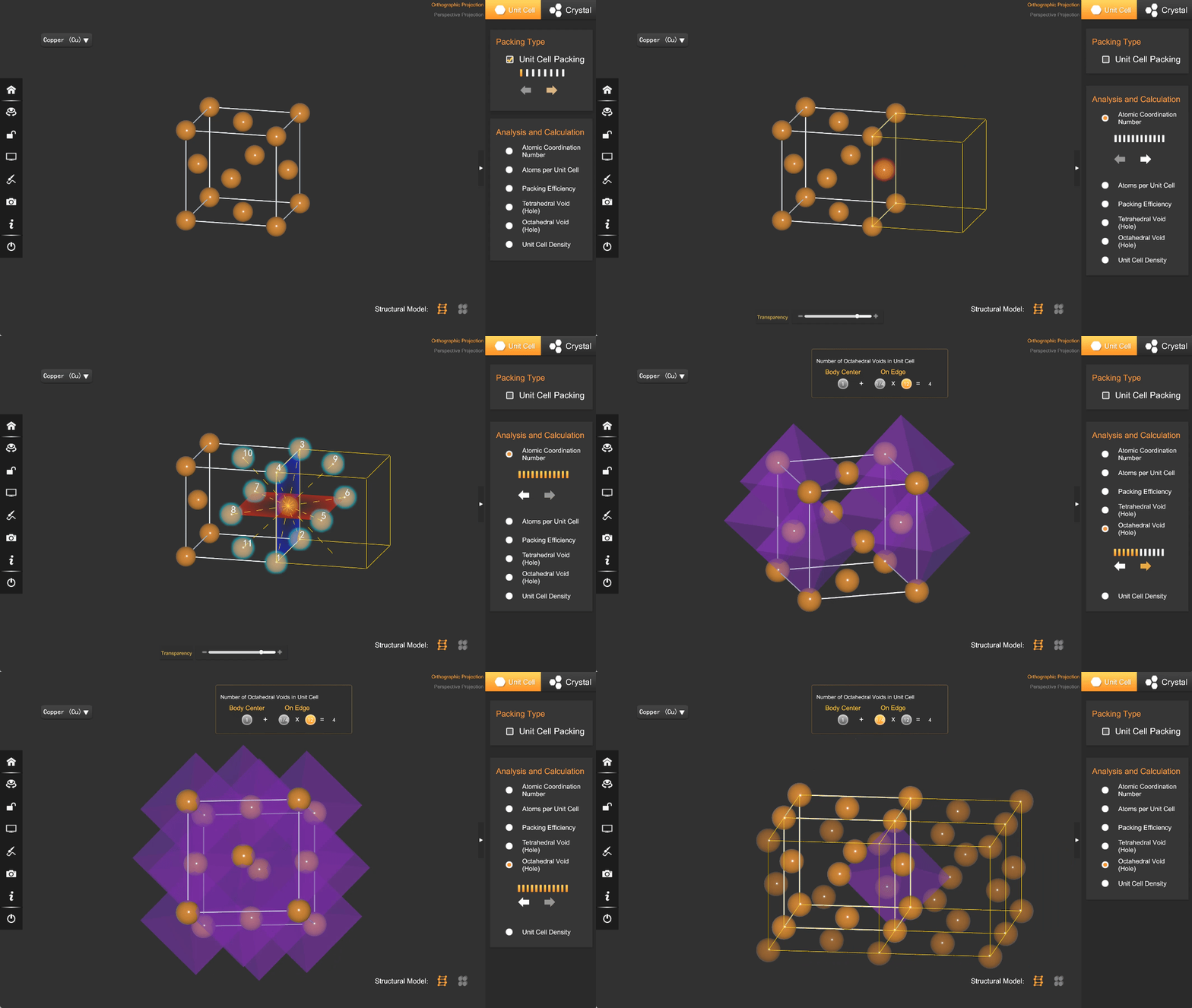
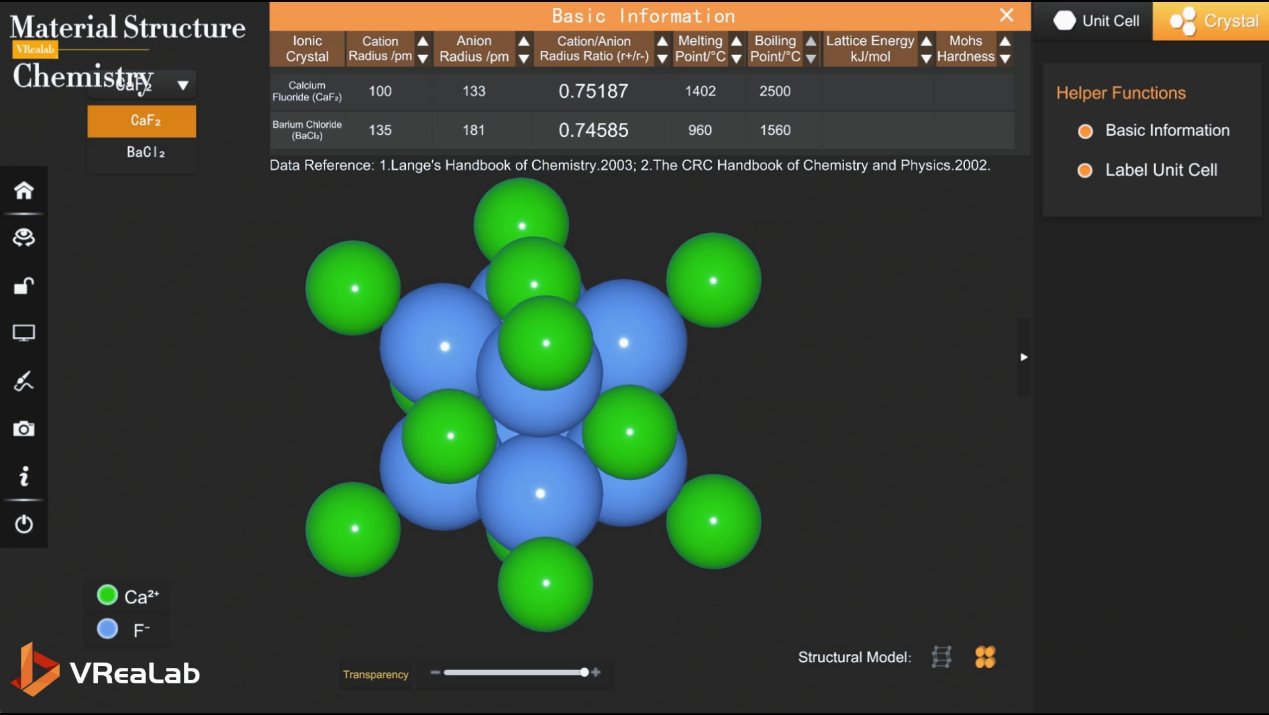
VReaLab Chemistry Material Structure is designed to change this. Its crystal structure module dissects 3D unit cells to simplify crystal packing models and particle distribution calculations, transforming abstract formulas into tangible, process-oriented workflows. At the heart of this transformation is Crystal Structure Visualization — the ability to see, rotate, and interact with crystal lattices in fully immersive three-dimensional space.
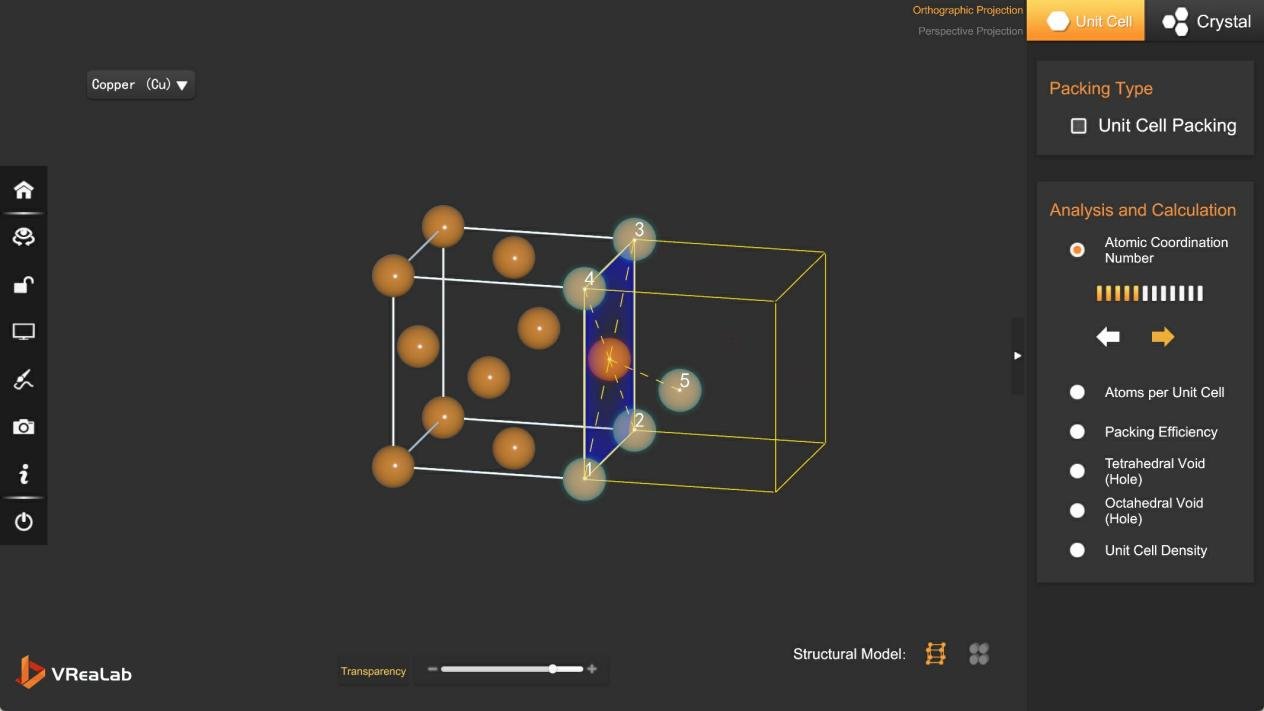
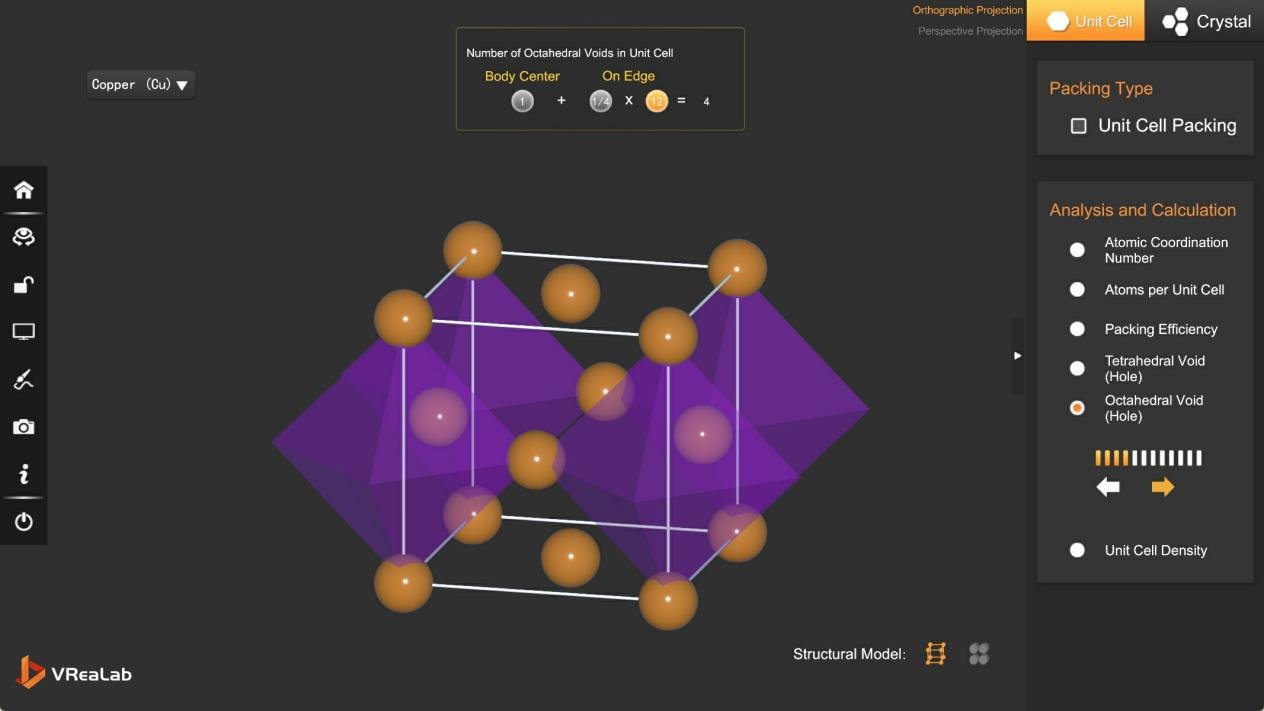
Consider the face-centered cubic close-packing arrangement, the copper-type structure that serves as a foundational example in most curricula. In a traditional lesson, students encounter this structure as a two-dimensional projection with labeled atoms and arrows indicating packing direction. They must mentally reconstruct the three-dimensional arrangement, identify which atoms belong to which unit cell, and then apply formulas for coordination number, atom count, and packing efficiency — all without ever seeing the actual structure in three dimensions. Crystal Structure Visualization removes this barrier entirely. Students can rotate the unit cell freely, zoom into specific atomic positions, and observe how the close-packing arrangement extends through space. Interactive calculators for coordination number, atom count, packing efficiency, voids, and density are embedded directly within the model, so students can change a parameter and immediately see its structural effect.
This approach does more than make crystallography easier — it makes it logical. When students can see that each atom in an FCC structure is surrounded by twelve nearest neighbors, the coordination number of twelve is no longer an arbitrary fact to memorize. It is an observable feature of the structure. When they can count the fractional contributions of corner atoms and face-centered atoms to a single unit cell, the atom-count formula becomes a geometric argument they can verify visually. Crystal Structure Visualization turns calculation from a mechanical exercise into a spatial reasoning process, exactly as the topic was meant to be learned.
The power of this system extends beyond crystallography. The same platform that delivers Crystal Structure Visualization also provides an Atomic Structure Simulation that visualizes electron clouds, atomic orbitals, and step-by-step electron-filling sequences for elements like copper. Students can trace the connection from atomic architecture to metallic bonding to crystal packing, seeing how the properties of individual atoms give rise to the macroscopic structure of the metal. This integrated approach links the logical chain of structure, property, and transformation that lies at the heart of chemistry education.
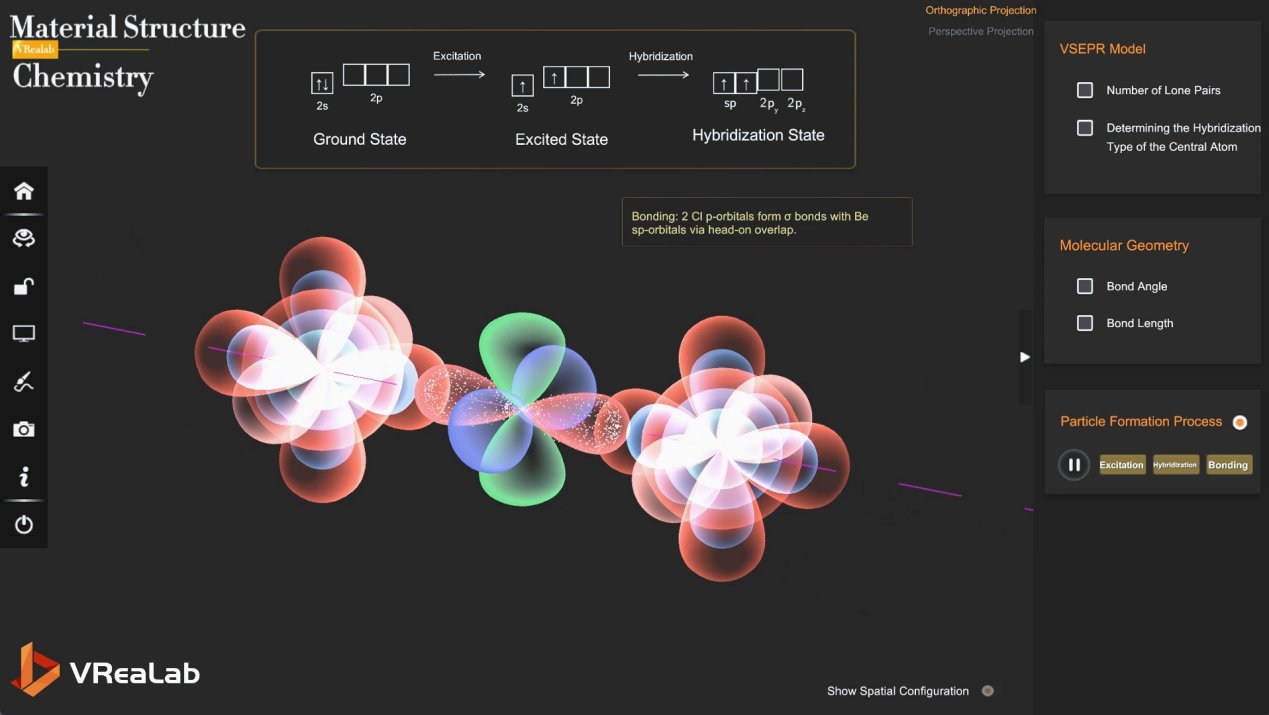
Similarly, the molecular structure module adds another layer of understanding. By exploring 3D Chemistry Structure models of molecules like BeCl2, students learn how VSEPR theory and hybrid orbital models predict molecular geometry. They observe covalent bond formation dynamically, manipulate bond parameters through interactive tools, and watch as individual atoms assemble into a complete 3D Chemistry Structure with specific polarity and properties. The same visualization philosophy that makes crystallography accessible — show, don’t tell — applies equally to atomic and molecular structure.
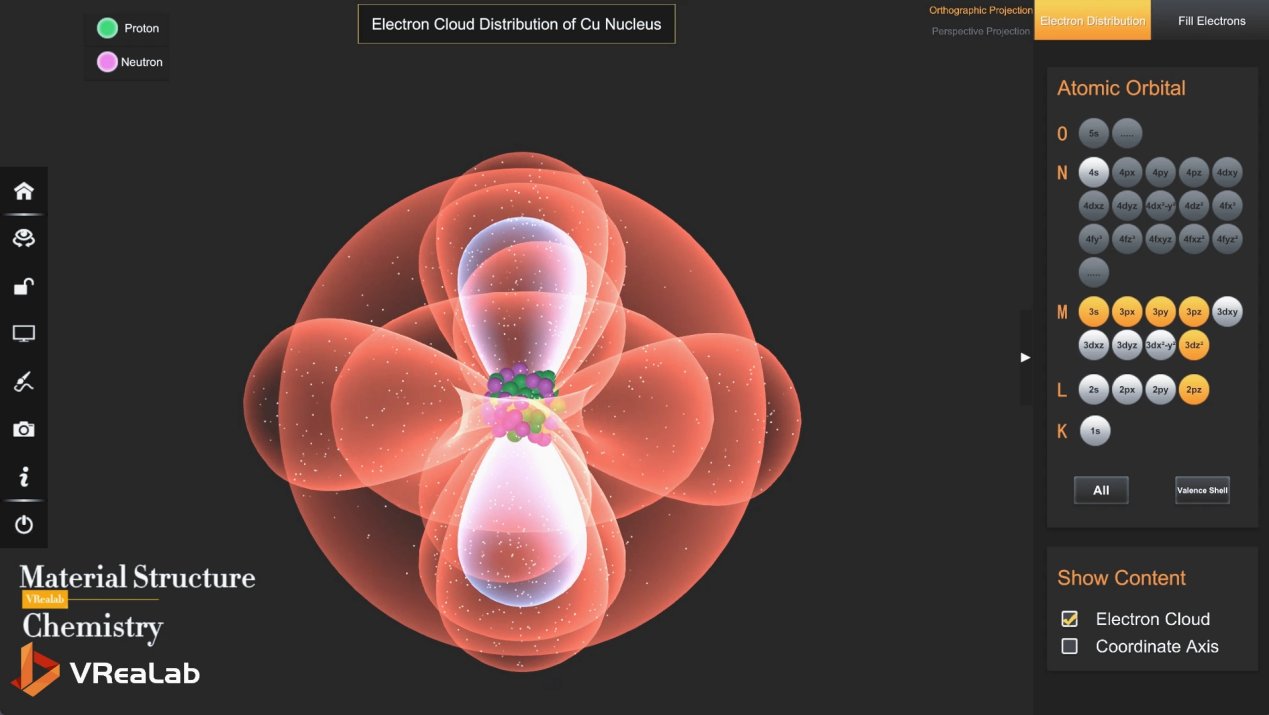
Together, these three modules form a unified learning experience. Atomic Structure Simulation builds the foundation at the subatomic level. The molecular structure module extends that understanding to bonded atoms. And Crystal Structure Visualization scales it up to the infinite repetition of the crystal lattice. By addressing every level of structural chemistry with the same immersive, interactive approach, VReaLab Chemistry Material Structure ensures that no student has to learn the hardest topics in chemistry blind. They can see the structures. They can manipulate the models. And they can understand — truly understand — the microscopic architecture of the material world.